
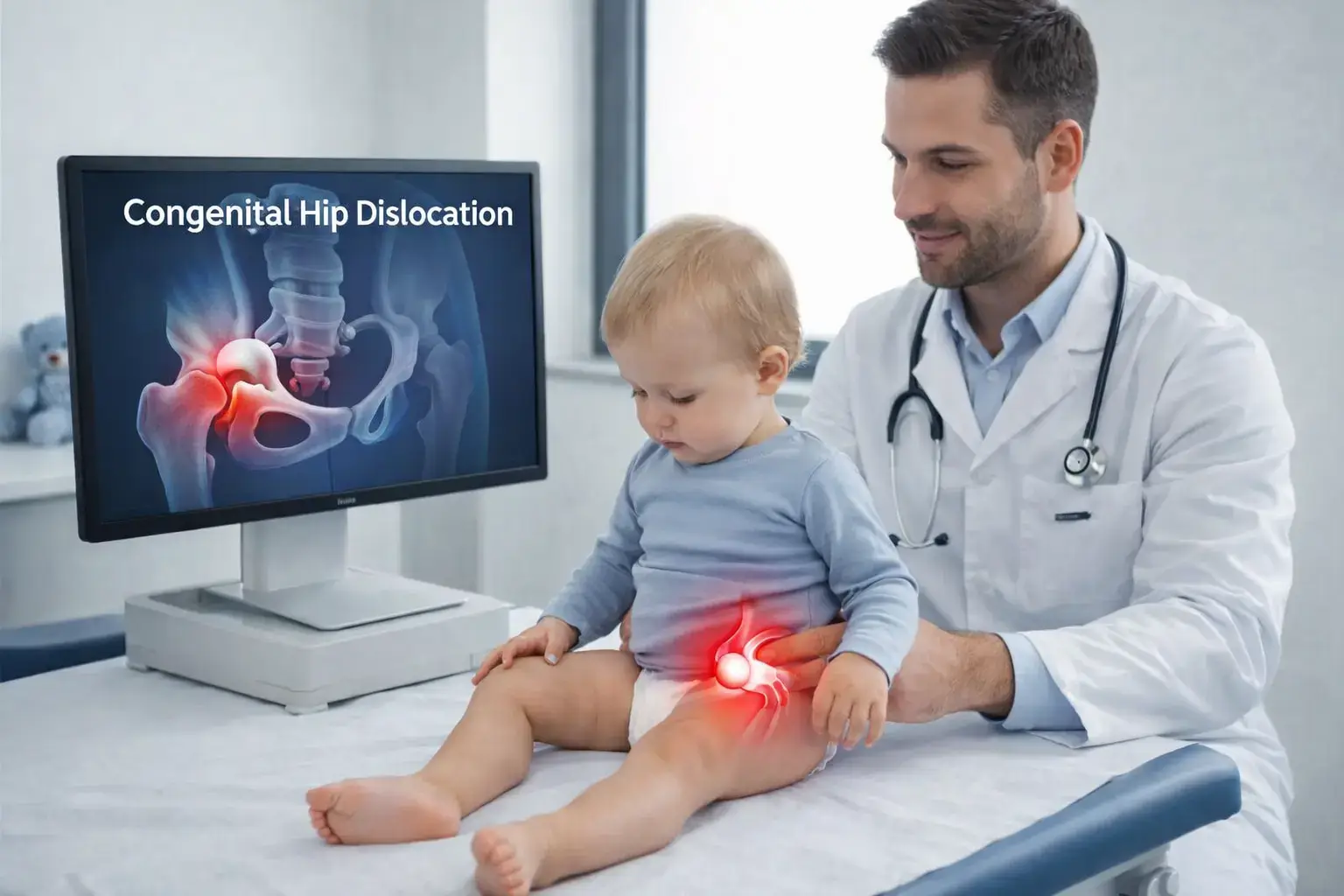
Understanding DDH in Infants
Developmental Dysplasia of the Hip (DDH) is a condition where the hip joint doesn't form correctly in babies. The ball (femoral head) may be loose in the socket, or completely dislocated. At Trinay Orthopedic Hospital, our goal is early detection and non-surgical correction whenever possible.
Secure your child's future mobility with our specialized care. Visit our About Us page for more information, or Contact Us for an expert opinion.
The Importance of Early Screening
If caught within the first few weeks of life, DDH can often be treated simply with a soft brace. We offer expert clinical screening and specialized pediatric assessment for accurate diagnosis.
Treatment Approaches by Age
Pavlik Harness
A dynamic soft brace that holds the hips in a developmental position, allowing the socket to deepen naturally without surgery.
Closed Reduction & Spica Casting
Gently placing the hip back into the socket under anesthesia and applying a specialized chest-to-toe cast (Spica) to keep it in place.
Open Reduction & Pelvic Osteotomy
For older children or resistant cases, we surgically reshape the socket or femur to ensure perfect joint alignment and prevent early arthritis.
Our specialized pediatric team ensures that every child receives a customized plan that prioritizes joint longevity and a normal, active childhood.